Sketch Your Day: A Simple Visual Vocabulary for Notes

Today we will build a simple visual vocabulary for everyday notes, turning quick lines, shapes, and friendly icons into a personal shorthand that speeds thinking and strengthens memory. Expect practical drills, tiny wins, and stories that prove clarity grows from playful sketches you can draw anywhere.

Why Drawing Your Notes Works

Dual Coding, Made Practical

Combine a short label with a simple icon to create two retrieval cues for one idea. Write the word decision and draw a check box; later, either the word or the square will trigger recall. This pairing reduces cognitive load and clarifies intent during collaboration.

Faster Than Writing Alone

Sketching abbreviates complexity. An arrow replaces a paragraph of transitions, while a clock glyph stands in for a long timestamp. Your pen's movement becomes thinking in motion, converting rambling sentences into relationships, flows, and anchors you can scan rapidly during conversation or review.

Memory Anchors You Can Trust

Small icons act as landmarks in a sea of text. A lightbulb consistently signals ideas, while footprints consistently show progress. Repetition builds recognition, and recognition beats recall for speed. Over time, your consistent set becomes a navigational map your future self instantly understands.

Five Strokes to Draw Almost Anything

With five strokes—dot, line, angle, arc, and shape—you can sketch containers, connectors, and emphasis marks that cover nearly every meeting, class, or planning session. These basics require no art training, yet they dramatically raise clarity, reduce hesitation, and invite teammates into the conversation.

Everyday Icon Set You Can Learn in an Hour
Work, Tasks, and Tools

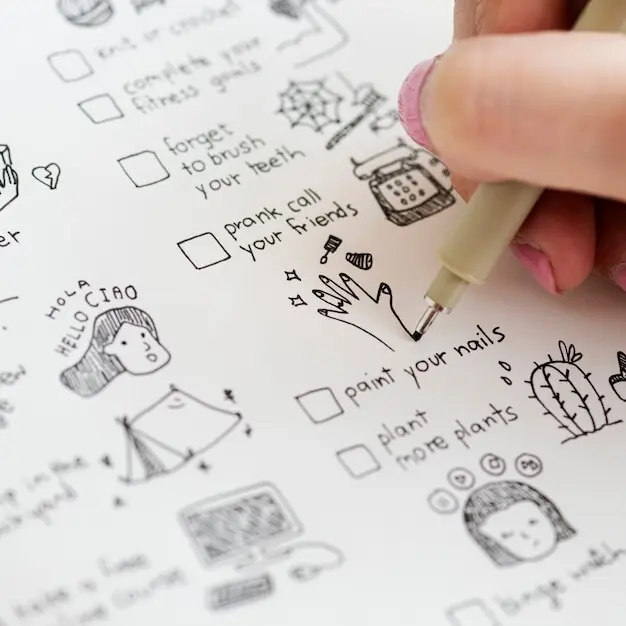
A checkbox paired with a wrench instantly marks an actionable task with effort implied. Paper with a folded corner signals a document; add a tiny chain for attachment. Use a spark line to denote blockers, then pair arrows with dates to show clear next steps.

People, Talk, and Decisions

Stick figures with speech bubbles convey roles and dialogue, keeping personalities generous and conflict de-escalated. Add name tags or initials for clarity. When agreement happens, draw interlocking circles; if not, split the bubble and add a question mark to capture unresolved decisions without blame.

Time, Progress, and Priority

A tiny calendar square, a sand timer, and a progress bar cover most scheduling conversations. Show priority with a bold exclamation inside a triangle. For partial completion, shade the bar diagonally, then label a percentage so your future self reads status instantly without reinterpreting symbols.

Layouts and Hierarchy That Read Themselves

Readers follow paths you design. Clear headings, grouped modules, and intentional white space reduce friction, making complex meetings legible at a glance. Think in panels, not pages; combine overview, details, and actions so scanning reveals context first, meaning second, and commitments last with confidence.

Color, Shading, and Contrast with Restraint

Color is a spotlight, not decoration. A restrained palette keeps signal-to-noise high, especially when scanning camera phone photos later. Favor black or dark gray ink for structure, then deploy one accent hue for highlights and a soft gray for shadows that add depth.

Two Pens, One Highlighter Strategy

Carry a dark fineliner for outlines, a brush pen for headings, and a single highlighter for emphasis. This kit travels anywhere, limits choices, and speeds decisions. When constraints remove fiddling, attention returns to listening, thinking, and shaping meaning rather than decorating empty margins.

Shadows with Lines, Not Markers

Use diagonal hatching under icons and along the right edge of containers to suggest volume without muddying text. A few consistent strokes add hierarchy invisibly. Photos reproduce line shadows more reliably than gray markers, preserving contrast when you share notes on screens or printouts.

Icons, Legends, and Accessibility

Pair color with labels so meaning survives grayscale photocopies and color blindness. Add a tiny legend explaining your marks at the page edge. Inclusive notes invite broader participation, reduce misunderstandings, and make your visual vocabulary useful to teammates using different tools, screens, or printers.

Daily Drills, Workflows, and Sharing
Skills grow with playful repetition and light structure. Short drills strengthen muscle memory; reusable templates remove friction; simple sharing keeps momentum. Capture wins, invite feedback, and adjust your set monthly so it reflects real meetings, real study sessions, and real lists you actually complete.
Zavovirolivoveltolumanilo
Privacy Overview

This website uses cookies so that we can provide you with the best user experience possible. Cookie information is stored in your browser and performs functions such as recognising you when you return to our website and helping our team to understand which sections of the website you find most interesting and useful.